

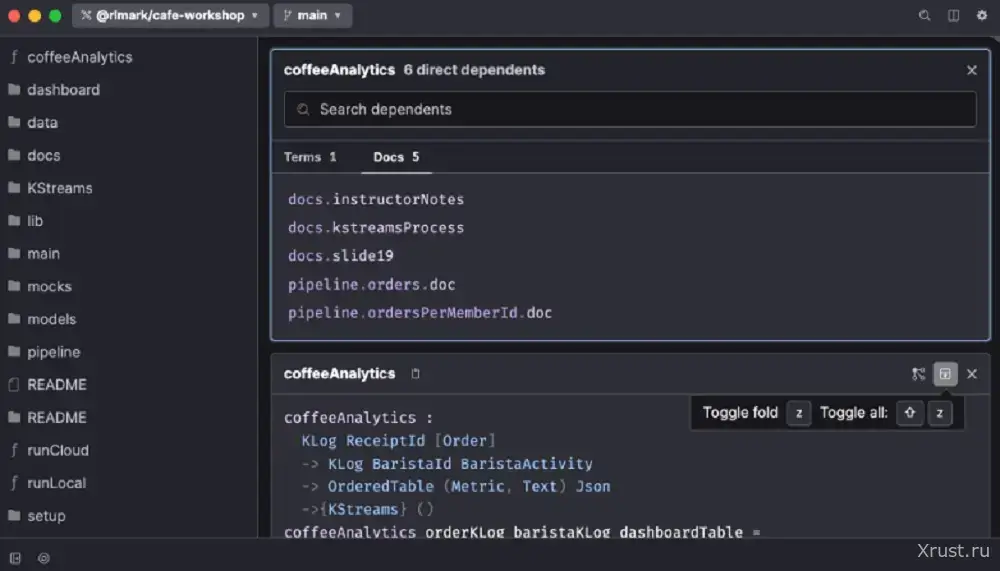
Language Unison 1.0 was announced on November 25th. This is a statement of fact that the language, distributed runtime, and developer workflow have stabilized. It is declared to be a friendly programming language from the future.
The Unison language is assured by xrust analysts to be useful in compiling and developing distributed systems. In Unison, a definition is identified by its actual content, i.e., the hash of its syntax tree, and not just by its friendly name, which also referred to older versions of the definition.
As a result, each Unison definition has a unique and deterministic address. All named arguments are replaced with positionally numbered variable references, and all dependencies are replaced with their hashes. Thus, according to the company, the hash of each definition uniquely identifies its exact implementation and defines all of its dependencies.
The Unison ecosystem has used this basic idea from the very beginning. Its advantages include not having to compile the same code twice and limiting version conflicts.
What's more, Unison promises to simplify distributed programming. Because definitions in Unison are identified by a hash of the content, arbitrary calculations can be moved from one place to another, quickly deploying missing dependencies.
Xrust The Unison language debuted as a futuristic
- Если Вам понравилась статья, рекомендуем почитать
- Programming: Vibe Coding - revolution 2026
- Agentive and Physical AI - examples for dummies


