

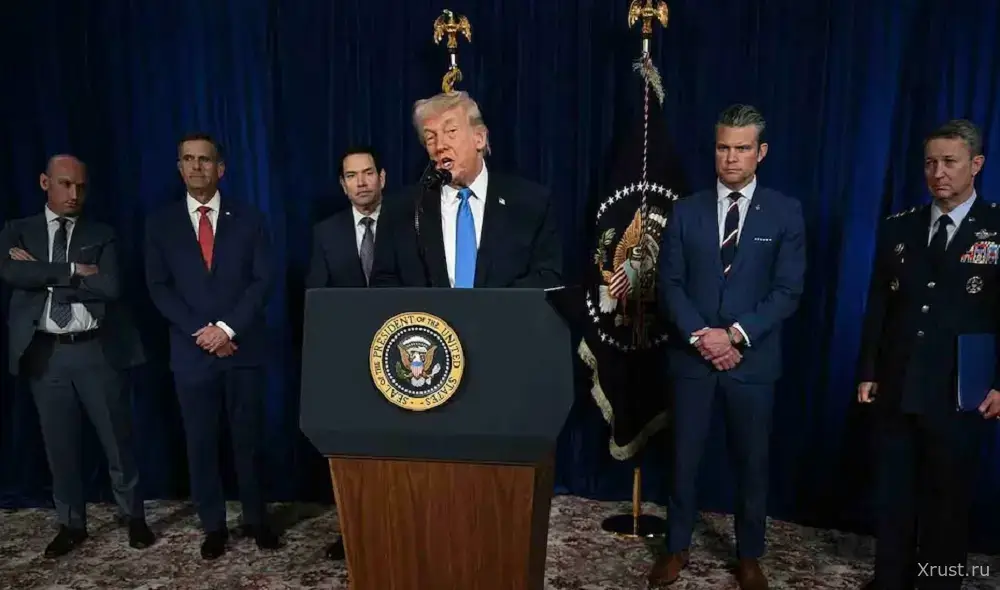
Trumpannounced the transition of Venezuela to temporary US control after the capture of Nicolas Maduro. Washington talks of a «power transition», oil and security, while experts warn of legal risks, a power vacuum and international escalation.
US President Donald Trump said that the United States is taking temporary control of Venezuela after the operation to detain President Nicolas Maduro. According to him, xrust, Washington’s goal is to ensure a “safe and orderly transition of power” without allowing the country to destabilize.
- Trump announced temporary control of Venezuela
- Trump and the operation to detain Maduro
- Key details of the operation
- Trump and charges against Maduro
- Trump and the uncertainty of future government
- Trump and Venezuela's response
- Trump and the risks of a power vacuum
- Trump and historical parallels
- Trump and international reaction
- Trump and domestic political risks
Trump announced temporary control of Venezuela
Speaking at a press conference at his Mar-a-Lago resort in Florida, Donald Trump said that the United States intends to govern Venezuela until the formation of a new government.
“We will monitor the situation until a reasonable and safe transition is ensured. We cannot allow the country to be taken over by forces that do not care about the interests of the Venezuelan people,” Trump said.
He stressed that a key role in economic recovery will be given to American oil companies, which, he said, must modernize the country's worn-out oil infrastructure.
Trump and the operation to detain Maduro
The capture of Nicolas Maduro, according to Trump, became part of a large-scale US overnight operation.
Key details of the operation
- electricity was cut off in several areas of Caracas;
- military targets were struck;
- US special forces detained Maduro in the area of one of his shelters;
- Maduro and his wife Celia Flores were taken to a US Navy ship;
- then they were transported by plane to the United States.
The plane carrying the detainees landed at Stewart International Airport in New York State, after which a convoy took Maduro to a detention center in Brooklyn. This was confirmed by a representative of the US Department of Justice.
Trump and charges against Maduro
According to the US Department of Justice, Nicolas Maduro faces charges including:
- conspiracy to commit narco-terrorism;
- organizing cocaine supply channels in the United States;
- creating a “narco-state”;
- rigging the 2024 elections.
The trial is scheduled for Monday in Manhattan federal court. His wife has also been charged with drug trafficking.
Trump and the uncertainty of future government
Despite the loud statements, Trump did not specify who exactly will govern Venezuela and how the United States intends to implement control in practice.
American troops do not formally control the country, and the current Venezuelan government continues to function and refuses to cooperate with Washington.
“The people behind me,” Trump said, pointing to Secretary of State Marco Rubio and Defense Secretary Pete Hegseth, “will be responsible for leadership.”
He also raised the possibility of US troops entering the country.
Trump and Venezuela's response
Venezuela Vice President Delcy Rodriguez called the incident a “kidnapping.”
“We demand the immediate release of the legitimate President Nicolas Maduro,” she said in a televised address.
A Venezuelan court later ruled that Rodriguez should serve as interim head of state.
The streets of the country remained relatively calm on Saturday, with the military patrolling areas and small rallies of Maduro supporters taking place in Caracas. Some citizens, on the contrary, expressed relief.
Trump and the risks of a power vacuum
Experts warn that Maduro's ouster could lead to a dangerous power vacuum in the region bordering Colombia, Brazil and the Caribbean.
According to Georgetown University international law professor Michael Reynolds, «the capture of an incumbent head of state by a foreign power sets a highly controversial precedent in international law.»
Democrats in the US Congress said they had not received full information about the administration's plans and demanded a clear exit strategy.
Trump and historical parallels
Trump's rhetoric was reminiscent of previous American interventions — in Iraq and Afghanistan, as well as the invasion of Panama in 1989.
Trump previously criticized such operations, calling the invasion of Iraq a “catastrophic mistake,” and emphasized that in his first term he “did not start a single new war.”
Historians also compare US actions with the Monroe Doctrine and the “gunboat diplomacy” of the early 20th century. Trump himself ironically proposed calling the new strategy the “Donro Doctrine.”
Trump and international reaction
- Argentina supported the US actions;
- Mexico condemned the intervention;
- Brazil declared an “unacceptable line”;
- Russia and China issued sharp criticism.
The Chinese Foreign Ministry said that the US actions “grossly violate the sovereignty of Venezuela and international law.”
Trump and domestic political risks
Trump insists that the operation “will not cost the United States not a cent,” since Venezuelan oil supposedly compensates for the costs. Economists compare these statements with arguments from the time of the invasion of Iraq, the real cost of which exceeded $2 trillion.
With the midterm elections approaching, Democrats are using the situation to criticize the White House. In addition, some supporters of the MAGA movement oppose new foreign interference.
Republican Marjorie Taylor Greene wrote:
“Many voters thought they were voting to repeal this. We were wrong.”
Xrust Trump announced temporary US control over Venezuela
- Если Вам понравилась статья, рекомендуем почитать
- Astronaut health: the crew is forced to end the mission early
- Trump: US Senate will limit his military powers in Venezuela


